MeesterDaan (talk | contribs) |
MeesterDaan (talk | contribs) |
||
| Line 42: | Line 42: | ||
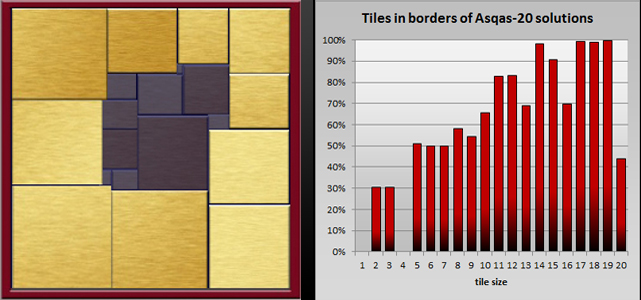
So we needed some tricks to tip the odds in our favour. Such are called "heuristics" if they involve a(n educated) guess and "optimizations" if they just speed up the computation process. We pryed a valuable heuristic out of a smaller instance, the ASQAS-20. This instance had 54,992 solutions (which maybe isn't that many) and most of these had borders consisting mostly of large tiles. We figured that this might be true for ASQAS-34 instance too, so we decided to make all borders of 12 tiles. | So we needed some tricks to tip the odds in our favour. Such are called "heuristics" if they involve a(n educated) guess and "optimizations" if they just speed up the computation process. We pryed a valuable heuristic out of a smaller instance, the ASQAS-20. This instance had 54,992 solutions (which maybe isn't that many) and most of these had borders consisting mostly of large tiles. We figured that this might be true for ASQAS-34 instance too, so we decided to make all borders of 12 tiles. | ||
| + | |||
| + | |valign="top" |[[Image:ASQAS20heur.jpg|frame|link=Heuristieken|Left-to-right: Mark Moes, Emiel Suilen & Florian Braam who did most of the ground work. Bottom right is me (Daan van den Berg), I did coordination and wrote the paper's first draft. Top right is Sandjai Bhulai who also did some writing and took care of the entire publication process. A good team.]] | ||
Revision as of 11:50, 21 November 2016
Introduction
ASQAS-34 is a perfect rectangle packing problem solved by Braam, Moes, Suilen, Van den Berg and Bhulai in 2016 and earlier (unpublished) by Giovanni Resta. I'm still working on this page, but our paper is here. I (Daan van den Berg) welcome all feedback you might have. Look me up in the UvA-directory, on LinkedIn or FaceBook.
Q&A
| 1. What is ASQAS-34 ?
|
 This is Asqas-34: consecutive almost-square tiles to be fit in an almost-square frame. There are 5 instances of ASQAS, and ASQAS-34 was the only unsolved instance yet. |
| 2. Is it a hard problem?
|
 Solution found on the server of Cees van Leeuwen's [lab for perceptual dynamics] in Leuven. Thanks to Marco Maas for helping out too. |
| 3. So how did you solve it?
|
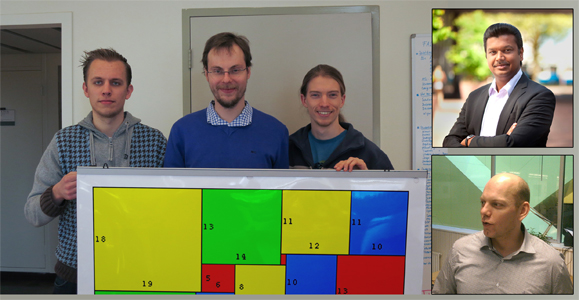
 Left-to-right: Mark Moes, Emiel Suilen & Florian Braam who did most of the ground work. Bottom right is me (Daan van den Berg), I did coordination and wrote the paper's first draft. Top right is Sandjai Bhulai who also did some writing and took care of the entire publication process. A good team.
|
| 3. Then what?
|
Left-to-right: Mark Moes, Emiel Suilen & Florian Braam who did most of the ground work. Bottom right is me (Daan van den Berg), I did coordination and wrote the paper's first draft. Top right is Sandjai Bhulai who also did some writing and took care of the entire publication process. A good team. |
| 4. You call yourselves an "VU-UvA consortium". Why is that?
Because we are a true VU-UvA collaboration. Mark, Florian and Emiel were VU-students when we started this work. They're all professionals now, and Emiel does some occasional work in proofreading Heuristics-reports at the UvA. That's where I work, in the "minor programming" (www.mprog.nl) where we teach the course of Heuristics. That course was originally built up at the VU back when I worked there so there's another link. Our colleagues teaching Heuristics at VU are Guszti Eiben and Bushra Malik. Sandjai, our senior author, also works at the VU as a Full Professor Business Analytics. He works on state-space reductions which is exactly the trick we deployed to solve ASQAS-34. |
 Left-to-right: Mark Moes, Emiel Suilen & Florian Braam who did most of the ground work. Bottom right is me (Daan van den Berg), I did coordination and wrote the paper's first draft. Top right is Sandjai Bhulai who also did some writing and took care of the entire publication process. A good team. |